Black History Month: Meshia Wallace M.D.
February 11, 2025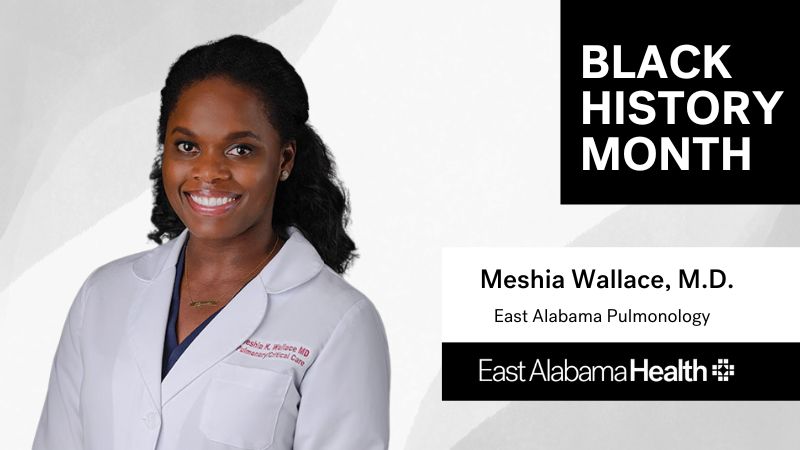
Meshia Wallace, M.D. practices at East Alabama Pulmonology. She grew up in Brooklyn, New York, and was a nurse for 10 years prior to attending medical school. Dr. Wallace received her medical degree from Ross University School of Medicine, where she graduated with honors, and completed her fellowship in pulmonology/critical care and residency in internal medicine at Augusta University Medical Center in Augusta, Georgia.
What inspired you to pursue a career in medicine, and did your background or upbringing influence this decision?
I always knew I would be in service of some kind. After becoming a nurse and noting the impact that I had on patient's lives I wanted to learn more. I decided to pursue medicine to satisfy this thirst for knowledge while continuing my quest to help patients.
What do you think is the most important issue facing Black communities in healthcare today, and how can physicians help address it?
Unfortunately, there are many issues facing our Black community in health care today. One of the most important is access and affordability. Many Black individuals are underinsured or uninsured, and this limits access to preventive care and treatment. There are also geographic disadvantages. For example, closures of hospitals in predominantly Black communities which further restricts access to quality care. Although I am hopeful that this next issue is being addressed, studies have shown Black patients often receive lower quality care due to implicit bias among health care providers. Pain in Black people is often underestimated leading to undertreatment of conditions such as chronic pain and sickle-cell disease. Unfortunately, Black women are three times more likely to die from pregnancy-related complications as white women, regardless of income or education. This is likely due to inadequate prenatal care, medical neglect and systemic racism in health care. As mentioned before, there are many issues facing the Black community. One way to combat it is through policy and systemic changes. We need to advocate for policies that will improve Medicaid expansion and increased sepsis days for insurance that will in turn reduce barriers to care. We can form outreach programs to educate all people about the need for preventive medicines. Often, these programs will need to be brought to the doorsteps of our patients in places where they gather, such as church, games, etc.
What advice would you give to young Black students interested in pursuing a career in healthcare or medicine?
My advice would be to pursue medicine with a goal of providing quality care to your future patients. If this is your goal, I think it will help guide you through the prerequisites to becoming a physician. You will study not simply to pass the test, but to have a deep understanding of the subject matter because this will benefit your patients in the future.
Can you share a memorable story or experience from your early career that shaped your path?
While working as a nurse in the emergency department in Brooklyn, New York, a patient was brought in via ambulance and was unresponsive with multiple obvious fractures including a broken neck.
He was riding with his parents to his brother's graduation. He was in the backseat. Traffic was at a stop (per his mother's report) when he opened the door, stepped out and jumped off an overpass, resulting in the injuries which brought him to the emergency department.
I saw several things that day that shaped, and continues to shape, the way I view not only myself, but my colleagues in the world around me. His appearance was strange for multiple reasons. Never before in this emergency department had we had an attempted suicide off the overpass of the Belt Parkway. He was also white in a predominantly Black neighborhood, as he was just passing through to get to Long Island. What I saw was a predominantly minority staff gathered around this individual without hesitation to save his life. Physicians, nurses (including myself), techs and respiratory therapists all gathered to save the life of someone in need. I see this daily still.
The second thing I saw was an obviously affluent young man (as I cut his Brooks Brothers clothing off his body) in despair who saw no other way out than to jump off an overpass. This told me that wealth is nothing without true happiness, and it brought home to me the importance of mental health and the devastating effects when it is not addressed.