Cardiologist Reflects on 40th Anniversary of First Heart Catheterization at EAMC
July 10, 2025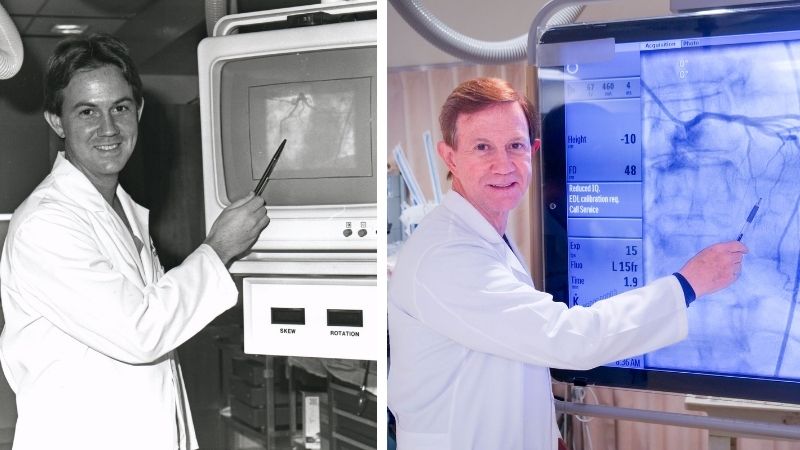
Categories: News
Tags: Cardiac Surgery, Cardiology
Forty years ago, on July 10, 1985, a youthful team at East Alabama Medical Center (EAMC) performed a heart catheterization, the first in hospital history. The procedure, used to detect coronary artery disease, marked a major milestone by bringing a life-saving procedure closer to home for patients in need.
John Mitchell, M.D., was the cardiologist who performed the landmark procedure, having joined the staff at EAMC just two weeks prior.
“This is a great milestone and we’re thankful for John’s role in the history of our cardiology program,” stated Laura Grill, East Alabama Health’s president and CEO. “His steadfast commitment to patients has helped build a strong foundation. We thank him for his 40 years of service to our hospital and our community.”
Mitchell and the hospital’s administrative team recognized a need within the area for more diagnostic procedures like heart catheterizations.
The response was overwhelmingly positive, as the new service offered patients both convenience and peace of mind.
“Prior to 1985, patients who needed a heart cath had to travel out of town to Birmingham, Atlanta or Montgomery,” Mitchell said. “Based on the number of patients being sent out, I projected we would do 120 caths that first year.”
In fact, the demand was so great that more than three times that number of patients would undergo the elective procedure over the next 12 months or so.
That first milestone opened the door to rapid growth for EAMC’s Cardiology program. The hospital would soon obtain a “certificate of need” for an open-heart surgery program, with the first open-heart surgery occurring in September 1987.
Grill began her career with the organization in 1992 as the director of Cardiology. Having witnessed the program’s growth firsthand, Grill has a unique appreciation for how far the hospital’s cardiac services have advanced over the years.
“It has been incredible to watch our Cardiology program evolve into a regional destination for high-quality care that is attracting patients from far beyond our immediate area,” stated Grill. “To see how far our organization has come is a testament to the decades of teamwork and innovation, as well as a deep commitment to our patients.”
The program’s continued growth has mirrored the growth of Lee County and surrounding areas.
Today, diagnostic heart catheterizations remain the hospital’s most common cardiac procedure. In 2024, the cardiologists practicing locally performed a total of 1417 heart catheterizations at EAMC, as well as 800 other interventions such as angioplasties and stents.
“Since completing that first heart cath, we’ve progressed to doing complex procedures that were unheard of in 1985,” stated Mitchell.
Patients now have access to a wide range of advanced procedures, including coronary artery bypass grafts (CABG, or “open-heart” surgery) and valve replacements. Minimally invasive treatments, such as transcatheter aortic valve replacement (TAVR) procedures, are also available to replace a diseased aortic valve with a synthetic valve.
The technology used for cardiac procedures has also evolved to match the level of advanced care offered at EAMC today. The monitor used during heart catheterizations in 2025 now stretches 58 inches, vastly exceeding the 19-inch monitor used during the first procedure in 1985.
EAMC has a reputation for providing exceptional cardiac care. In 2023, the facility earned designation as a Blue Distinction+ Center for Cardiac Care from BlueCross BlueShield of Alabama, as well as a Transcatheter Valve Certification from the American College of Cardiology.
“We’re constantly looking for ways to improve outcomes and offer our patients access to the best treatment options available,” Grill said. “Our focus is not just maintaining what we have built, but ensuring we are prepared to meet the future needs of our community.”
The many successes of the cardiology program today can be traced back to that first heart cath in 1985.
“As any hospital administrator knows, ‘as your heart program goes, so goes your hospital,’” said Mitchell. “The first heart cath in 1985 really put EAMC on the map [for cardiology], and what followed was the rapid growth of health care in our region.”
-###-
About East Alabama Health
East Alabama Health encompasses East Alabama Medical Center in Opelika, EAMC-Lanier Rural Emergency Hospital in Valley, the Spencer Cancer Center in Opelika, the Auburn Medical Pavilion and a host of other key medical clinics and practices that help provide a continuum of care to patients throughout an 11-county area. EAMC is a 314-bed regional referral hospital that is currently under construction to add 30 critical care beds. EAMC-Lanier Rural Emergency Hospital provides emergency and outpatient services while its campus also features a nursing home and an ambulatory surgery center. East Alabama Health employs about 3,800 people and is the second largest employer in the region, trailing only Auburn University.