East Alabama Health’s LPN Program Creates Opportunities
February 3, 2026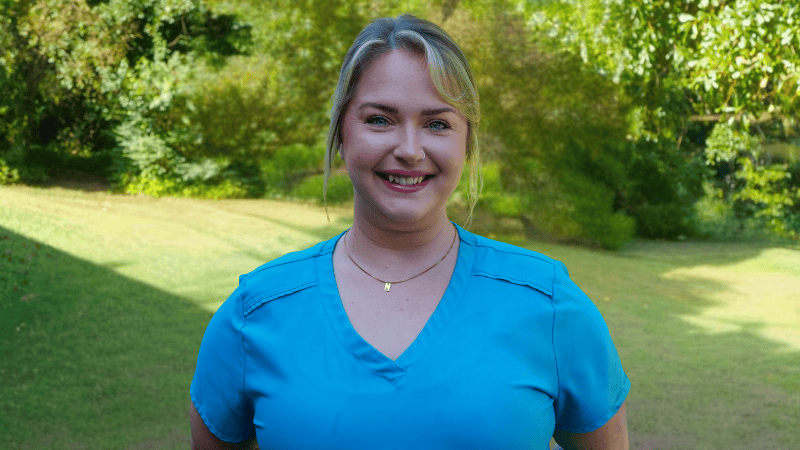
When Katie Reaves walked into a job fair at EAMC-Lanier Rural Emergency Hospital, she didn’t expect it to change her life. She arrived just before the event ended, hoping to find a new opportunity. What she found was the start of a career in health care.
“I got there with about 30 minutes left,” Reaves said. “I started talking to a group of ladies, and they offered me a position as an activities assistant at the Lanier Nursing Home. I was a little leery because I didn’t know what to expect, but I fell in love with it.”
That role gave Reaves her first glimpse into the teamwork and compassion that define nursing. She quickly realized how much she enjoyed being part of a team that worked together to care for residents. But she also knew she wanted more — a chance to grow professionally and make a bigger impact.
After nearly a year, Reaves learned about East Alabama Health’s Pathways to Advancement program, which helps employees pursue education while working. The program introduced her to the hospital’s newly developed on-site Licensed Practical Nurse (LPN) program, offered in partnership with Chattahoochee Valley Community College.
“Applying was scary,” she said. “I’d been used to taking care of other people, so this was my first time giving myself a shot at something. But I believed in myself, and I was accepted. That was huge.”
For Reaves, the program represented more than a career move — it was a lifeline. East Alabama Health covered her tuition, allowed her to keep full-time benefits, and worked around her schedule to reduce stress. That level of support, she said, made an intimidating leap feel possible.
“They worked around my work schedule and took off as much stress as possible, so it was possible to go back to school,” she said. “I was still able to keep my benefits, work full-time hours, and have tuition covered.”
The on-site LPN program spans three semesters and combines classroom instruction, labs , and clinical experience. Being part of the first cohort came with challenges, but Reaves said the support system was strong. Instructors, managers and classmates rallied to make sure everyone succeeded.
“We had a motto throughout the whole program: There is no first place,” Reaves said. “This is not a competition. The only goal is to finish with as many people as we can. We held each other accountable, quizzed each other, and encouraged each other.”
That camaraderie was critical for Reaves, who hadn’t been in school for nearly a decade. She admits the adjustment was tough at first, but the program’s structure—and the encouragement from her peers—helped her find her footing.
Midway through the program, Reaves joined East Alabama Health’s nurse apprenticeship program, which gave her hands-on experience and helped her meet clinical hour requirements. That experience, she said, transformed her confidence and her grades.
“As much hands-on experience as I could get made things click,” she said. “Starting in second semester, my grades constantly grew, and I can attribute a lot of that to the apprenticeship.”
The apprenticeship also allowed Reaves to self-schedule shifts around her classes, making it easier to balance work, school, and family responsibilities. That flexibility, combined with financial support, reflects East Alabama Health’s commitment to investing in its workforce.
“I’ve heard of people sleeping for just a few hours between school and clinicals, then go to their job,” Reaves said. “But with this program, I was able to work it as beneficial to myself and my schedule as I possibly could.”
After graduating, Reaves transitioned to a day-shift position in the hospital’s psychiatric unit—a role she calls a dream come true.
“I was prepared to swap to night shift, but I was offered a day-shift position in Psychiatric Services, which is unheard of,” she said. “It felt like another door opening because I took a chance on myself.”
For Reaves, the journey wasn’t just about advancing her career. It was about proving to herself and to her family that it’s never too late to pursue your goals. During the program, she balanced school with caring for her niece.
“I know some people say it’s never too late to go back, but others think, ‘I’m too old,’” she said. “I’m 29, and I handled my niece’s senior year, sports, her first car—all while doing this program. It was a testament to them that if I could overcome hardships and take a chance on myself; they could too.”
Looking ahead, Reaves plans to complete her remaining prerequisite and apply to an RN bridge program in the spring. Her advice to anyone considering the LPN program is simple.
“No one is going to believe in you more than you,” she said. “Once you start believing in yourself, the way doors open is astronomical.”
About East Alabama Health
East Alabama Health encompasses East Alabama Medical Center in Opelika, EAMC-Lanier Rural Emergency Hospital in Valley, East Alabama Medical Center North, the Spencer Cancer Center in Opelika, the Auburn Medical Pavilion and a host of other key medical clinics and practices that help provide a continuum of care to patients throughout an 11-county area. EAMC is a 316-bed regional referral hospital. EAMC-Lanier Rural Emergency Hospital provides emergency and outpatient services while its campus also features a nursing home and an ambulatory surgery center. East Alabama Health employs about 3,800 people and is the second largest employer in the region, trailing only Auburn University.