Hair loss is one of the most common side effects of cancer treatment, and for many patients, it can be one of the hardest. It is often the most visible sign of a diagnosis, and for some, it can feel like losing a part of who they are.
When 35-year-old Jenna Chambliss, a patient at Spencer Cancer Center, was diagnosed with breast cancer during the summer of 2026, one of her first questions was whether there was a way to keep her hair while undergoing chemotherapy.
“Losing my hair was probably at the top of my list when thinking about all of the things I was going to have to go through,” Chambliss said. “I have very thick hair. I love my hair. My hair was my favorite body part, is what I would tell everyone.”
When Chambliss asked her breast surgeon, Eric Manahan, M.D., whether Spencer Cancer Center offered scalp cooling therapy—commonly called cold capping—his initial answer was “not yet.” Manahan told her it was something he was actively looking into.
“At that point, I just gave [the situation] to God,” she recalled. “I was like, ‘okay, you can have my hair as long as you let me live.’”
Days later, her phone rang. It was Manahan, asking whether she would be willing to use a cold cap at her second treatment if Spencer Cancer Center could have one ready. Manahan had helped add scalp cooling therapy as a treatment option for patients.
“I had already given this one up,” Chambliss said. “But yes, we’re not going to say ‘no’ now.”
This innovative treatment option is designed to help patients preserve their hair during chemotherapy by cooling the scalp, which helps limit the amount of chemotherapy medication that reaches the hair follicles.
While success is not guaranteed with cold capping, Chambliss was willing to give it a try.
“I welcomed being the guinea pig, and I was very happy to be,” she said.
How does scalp cooling work?
Chemotherapy medicine travels through the bloodstream to reach cancer cells. Along the way, it can also reach the hair follicles, the tiny roots that grow hair, which can cause hair to thin or fall out.
A cold cap cools the scalp, which slows blood flow to the area. With less blood flow, less chemotherapy reaches the hair follicles, which may help patients keep more of their hair.
Cold caps are a supplemental treatment option for patients who are undergoing certain types of chemotherapy for a solid tumor.
There are two main types of cold caps. One is connected to a cooling machine and is approved by the Food and Drug Administration (FDA). The other is a gel-filled cap that is chilled in a freezer or refrigerator, and it is not FDA-approved.
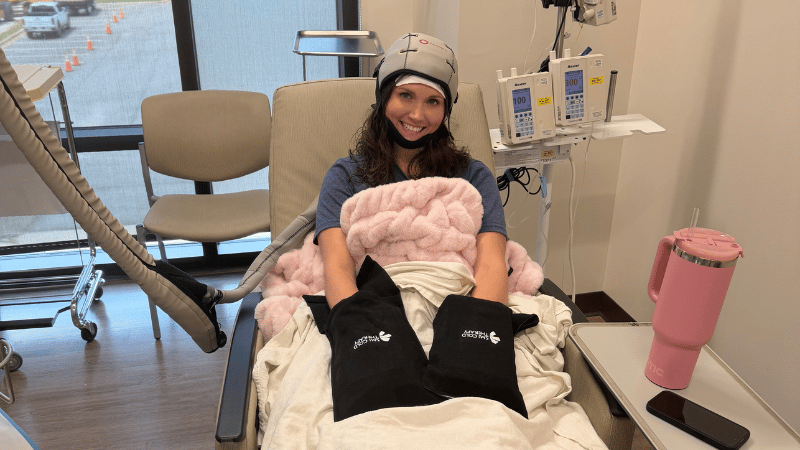
At Spencer Cancer Center, patients wear a snug, FDA-approved cold cap before, during and after treatment.
Chambliss says that wearing the cold cap during treatment hasn’t been a burden.
“[The cold cap] has not been hard at all,” she said.
Does scalp cooling treatment work for everyone?
While scalp cooling may potentially preserve hair, each person responds to chemotherapy differently.
Patients can still expect some shedding while using a cold cap.
“I know it’s not about the hair that is leaving my head, but it’s about the hair that I have left, and it’s also about the long game,” Chambliss said.
The long game, Manahan told her before she started, is what happens after treatment ends, when preserved hair follicles may help hair grow back faster. He also connected her with an online support group for cold cap users, where Chambliss has read posts from patients reporting regrowth in as little as 8 to 12 weeks.
Chambliss says the team at Spencer Cancer Center is embracing this new therapy option.
“The nurses every week come in, and it’s not even just my main nurses, but new nurses, and they’re wanting to get educated on it,” Chambliss said. “You can tell their intentionality and their care for the patients, because they really truly want the best outcomes for us, and that’s so uplifting.”
Her advice for anyone facing a new diagnosis is simple: “Ask all your questions. Don’t leave any stone unturned, because you, as a patient, are your best advocate.”
About East Alabama Health
East Alabama Health encompasses East Alabama Medical Center in Opelika, EAMC-Lanier Rural Emergency Hospital in Valley, East Alabama Medical Center North in Opelika, the Spencer Cancer Center in Opelika, the Auburn Medical Pavilion and a host of other key medical clinics and practices that help provide a continuum of care to patients throughout an 11-county area. EAMC is a 336-bed regional referral hospital. EAMC-Lanier Rural Emergency Hospital provides emergency care, outpatient services and surgery, while its campus also features a nursing home. East Alabama Health employs about 4,200 people and is the second largest employer in the region, trailing only Auburn University.