Finding hope close to home: a 35-year-old's breast cancer journey
November 9, 2026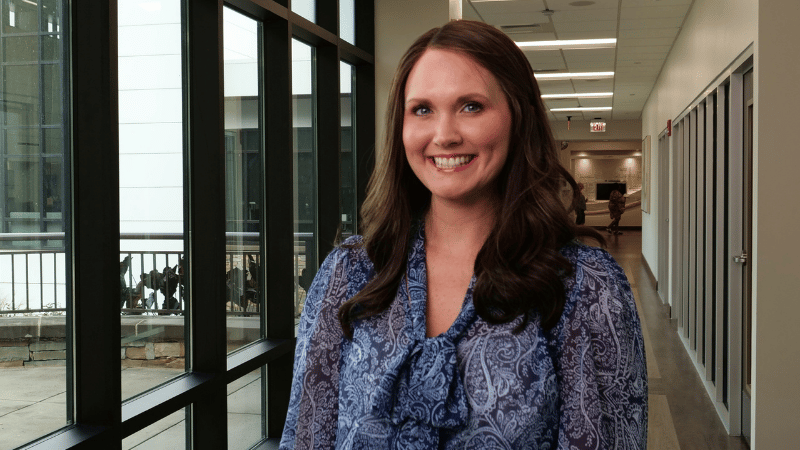
Categories: Patient Spotlight
Tags: Breast Cancer, Cancer
When Jenna Chambliss, 35, walked into Spencer Cancer Center for the first time, she and her husband brought plenty of questions—and fear. The Auburn mother of two says the care team at Spencer helped with both.
Her story began during the summer of 2026. During a routine self-exam, Chambliss noticed a tender spot on one of her breasts. Weeks later, it had not gone away. In fact, the pain had become more pronounced, leading her to meet with her physician who recommended a visit to the Breast Health Center in Auburn for further diagnostic evaluation.
Her visit to the Breast Health Center resulted in a concerning diagnosis: Stage 3 triple-negative breast cancer. With the news still sinking in, Chambliss and her husband went searching for answers.
A doctor who made room for her questions
Their journey led Chambliss to Spencer Cancer Center, where she met Eric Manahan, M.D., a breast surgeon and current president of the American Society of Breast Surgeons (ASBrS). Chambliss said his passion and poise stood out from the start.
“He was such a delight in such a dark and scary time,” Chambliss said. “He met my tears with a smile.”
Chambliss had already scheduled a second opinion at UT MD Anderson Cancer Center in Houston, but the appointment was more than a month away. When she told Dr. Manahan, he immediately went to work to help expedite the process.
He stepped out of the exam room and called a contact he knew in Texas. A few minutes later, he returned and told Chambliss she could be seen in two days. Thanks to his advocacy, she completed her evaluations in Houston well before her original appointment date.
The second opinion reached the same conclusion as her local team, and Chambliss returned to Spencer Cancer Center for treatment.
“I had all my answers that I needed because of Dr. Manahan,” Chambliss said.
“Being able to talk to patients on the front end and help them navigate this journey is one of the most rewarding parts of what I do,” Manahan said. “Every patient comes to us with questions, and I want them to leave with answers. Because, of course, the goal is for them to feel confident in their care.”
Manahan also paid attention to the details patients may not think to ask about.
Before chemotherapy could begin, Chambliss needed a port, a small device placed under the skin that gives nurses easy access to a vein for treatment and blood draws. When it came time to decide where it would go, she told Manahan she did not have a preference. He disagreed.
She recalled him saying, “I care, because in five years from now … you’re going to care.”
The port was placed low, where she says she barely notices it.
A chance to keep her hair
Losing her hair was among the things Chambliss dreaded most about her diagnosis. She had researched scalp cooling, also known as cold capping, and asked Manahan about it at their first meeting. At the time, Spencer Cancer Center did not yet offer it.
Days after her first treatment, Manahan called. If the center could bring in a cooling system for her second treatment, Manahan asked, would she be willing to try it?
“I was just like, ‘Oh my gosh!’” she said. “I had already given this one up, but yes, we’re not going to say no now.”
Cold capping does not guarantee a patient will keep all of her hair, and Chambliss said Manahan was upfront about that. She is still losing some hair, but she keeps her focus on the long game.
“It’s not about the hair that is leaving my head,” she said. “It’s about the hair that I have left.”
Tatyana Sklyar, M.D., Chambliss’s medical oncologist, has guided her throughout treatment, including her use of cold cap therapy.
“Cancer therapies often cause side effects that drain energy, affect mood and self-image, and make it harder to keep up with daily routines,” Sklyar said.
“Focusing on quality of life during treatment—such as using scalp cooling to help preserve hair—helps patients maintain confidence and the emotional resilience they need to stay engaged in life and better tolerate therapy.”
Chambliss also credits the nursing staff, who have been learning the system alongside her. Each week, she said, new nurses stop in to get educated on it.
“You can tell their intentionality and their care for the patients because they really truly want the best outcomes for us,” she said. “That’s so uplifting.”
Looking ahead
Chambliss is nearing the halfway point of chemotherapy. A midway scan, a second chemotherapy regimen, surgery and a month of radiation will follow. Her family, she said, is her source of strength.
“Even though there are many hard days in this, there is still much joy,” she said. “I have such a great husband, children and support system, and they have given me more motivation.”
Navigating a cancer diagnosis is difficult, but Chambliss said asking questions has helped ease her fear. It is the advice she would give anyone facing the same road.
“Don’t leave any stone unturned, because you, as a patient, are your best advocate,” Chambliss said. “There’s power in having answers, so ask any and all the questions that you have, whether they’re large or small.”
About East Alabama Health
East Alabama Health encompasses East Alabama Medical Center in Opelika, EAMC-Lanier Rural Emergency Hospital in Valley, East Alabama Medical Center North in Opelika, the Spencer Cancer Center in Opelika, the Auburn Medical Pavilion and a host of other key medical clinics and practices that help provide a continuum of care to patients throughout an 11-county area. EAMC is a 336-bed regional referral hospital. EAMC-Lanier Rural Emergency Hospital provides emergency care, outpatient services and surgery, while its campus also features a nursing home. East Alabama Health employs about 4,200 people and is the second largest employer in the region, trailing only Auburn University.