Lighter Loads, Better Patient Care: Researchers investigate how improving health care worker movement could boost patient outcomes
May 26, 2026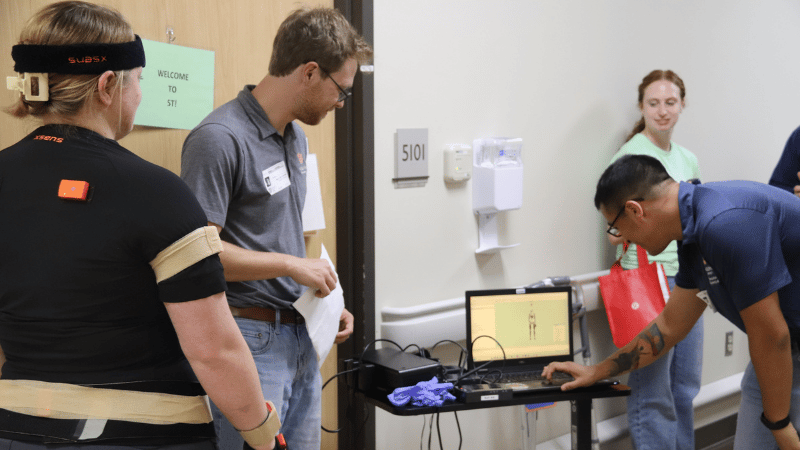
Categories: News
Tags: Clinical Research
The constant motion and weight load that health care workers absorb during their shifts—and careers—can have quite an impact on their bodies. Reducing that strain may not only protect hospital staffers, but also improve the care they provide to their patients.
A team of researchers from East Alabama Health, Auburn University and the Edward Via College of Osteopathic Medicine (VCOM) in Auburn, are studying how improving everyday health care movements like bending, lifting or crouching beside a bed could lead to better patient outcomes.
“The main idea is to improve quality of care,” said Iván Nail-Ulloa, Ph.D., a co-principal investigator for the project and postdoctoral fellow at Auburn University’s Biomechanical Engineering (AUBE) Lab.
“We’re expecting to help the health care workers, and the transitivity then goes to the patient, so they get better care,” explains Nail-Ulloa.
From helping patients adjust their resting position to providing support as patients perform rehabilitation tasks to regain function, health care workers are a prime example of Newton’s First Law: an object in motion stays in motion.
“When you think about the health care worker workload, you immediately think about moving patients who can vary tremendously in weight,” Nail-Ulloa said. “So, you assume that a lot of weight-loading will be associated with moving patients.”
Partnering with East Alabama Health’s Office of Clinical Research, the investigators are working directly with nurses, physical therapists and patients at East Alabama Medical Center (EAMC) to learn what tasks cause physical strain and then identify solutions.
“We’re really appreciative of the patients, their families, the staff and, of course, the East Alabama Health research team,” Nail-Ulloa said. “We are just extremely grateful for the enthusiasm and support that we have gotten here at EAMC, because these projects are not easy to implement.”
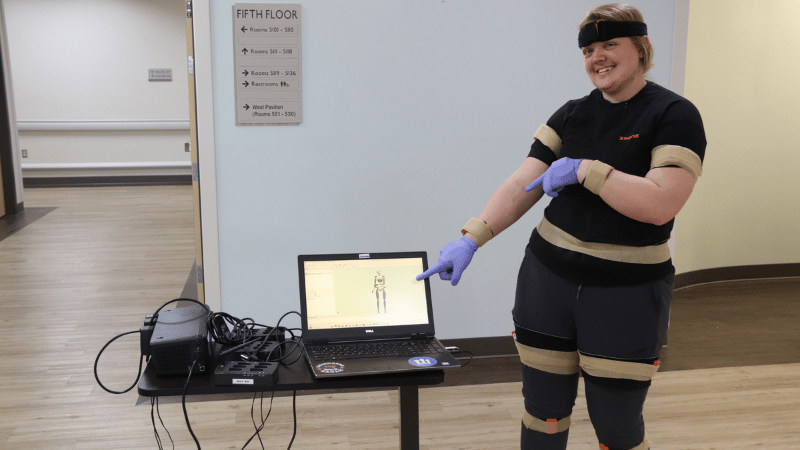
As part of the study, volunteers from areas like nursing, physical therapy and occupational therapy wear specialized gear equipped with 17 small sensors that record their motion during patient interactions. In addition, the researchers take video footage of worker and patient interactions when given permission by the patient. This allows them to capture motion data for body parts that the sensors do not capture, such as fingers.
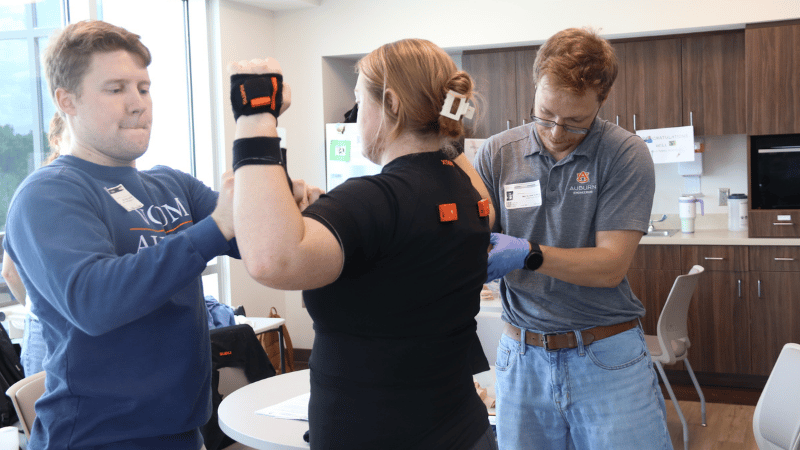
The sensor readings and videos are then entered into a motion capture system—a computer program that creates 3-D renderings, similar to the technology used in video games and major Hollywood films—giving the researchers a visual playback of the interactions to analyze the activities that cause the most strain on health care workers’ joints and lower back.
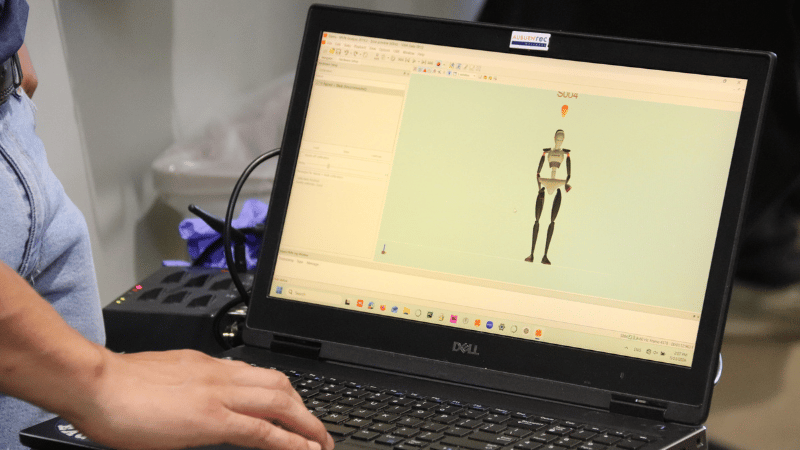
Since February, the investigators have been at EAMC collecting data. As the research progressed, the investigators discovered something unexpected: the human connection and emotional aspects of health care often play an understated role in how weight loads on the body.
“Something we observed is that sometimes health care professionals need to squat in front of patients for a long time while they are communicating or guiding them through what is going on, and that’s a lot of static effort,” said Nail-Ulloa. “The staff told us that ideally they want to be at eye-level with their patient to make communicating more personal.”
Treslyn Place, an occupational therapist at EAMC and research volunteer, is very familiar with the physical requirements of a career in health care. That is what drew her to volunteer for the study.
“My day-to-day involves lots of mobilizing patients, getting them out of bed, helping them stand up and overall get moving again,” Place said. “I was interested in the study because health care workers, especially physical therapists, occupational therapists and the people who move people are high-risk for injury.
“So, anything that can help us understand how to make body mechanics more efficient or learn about why we get injured would be helpful for our profession as a whole.”
The research project is a pilot study funded by a seed grant from VCOM and has brought together researchers from multiple disciplines.
Along with Nail-Ulloa, the other principal investigators include Nathan Douthit, M.D., a core faculty member of East Alabama Health’s Internal Medicine Residency Program and VCOM researcher; Michael Zabala, Ph.D., from Auburn University’s Department of Mechanical Engineering; and Mark Schall, Ph.D., from Auburn University’s Department of Industrial and Systems Engineering.
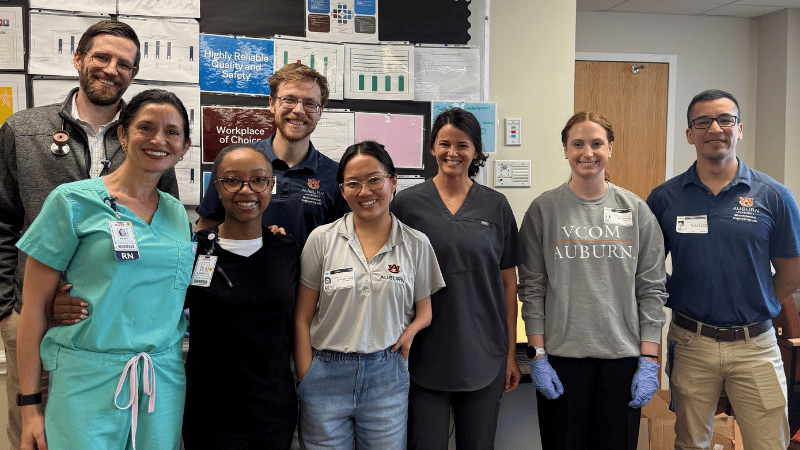
The field-based research project is also supported by engineering students Haley Evans, Jaxie Brokamp, Ryan Pollard, and Mary LeNoir, as well as second-year medical students from VCOM Suzanne Funk, Breana Piggot, Timothy Blanchette and Jacob Pruitt.
As a pilot grant study, one of the required outcomes from the research is a proposal to the National Institute of Occupational Safety and Health (NIOSH) outlining their findings as well as examples of potential solutions.
“Ideally, we could start trying or testing solutions such as passive exoskeletons or different weight-load strategies or training protocols,” Nail-Ulloa said. “As an engineer, I would like to test an exoskeleton here or investigate if we could modify an existing device for better targeted interventions based on scientific evidence. That is the end goal.”
As one of the region’s leading partners for health care research, East Alabama Health is a hub for clinical trials. To learn more about ongoing research and discover research opportunities that you may be eligible for, visit www.eastalabamahealth.org/research.
About East Alabama Health
East Alabama Health encompasses East Alabama Medical Center in Opelika, EAMC-Lanier Rural Emergency Hospital in Valley, East Alabama Medical Center North in Opelika, the Spencer Cancer Center in Opelika, the Auburn Medical Pavilion and a host of other key medical clinics and practices that help provide a continuum of care to patients throughout an 11-county area. EAMC is a 316-bed regional referral hospital. EAMC-Lanier Rural Emergency Hospital provides emergency and outpatient services while its campus also features a nursing home and an ambulatory surgery center. East Alabama Health employs about 4,100 people and is the second largest employer in the region, trailing only Auburn University.

Changing What's Possible
East Alabama Health is changing what's possible through clinical research opportunities and studies.
Learn More